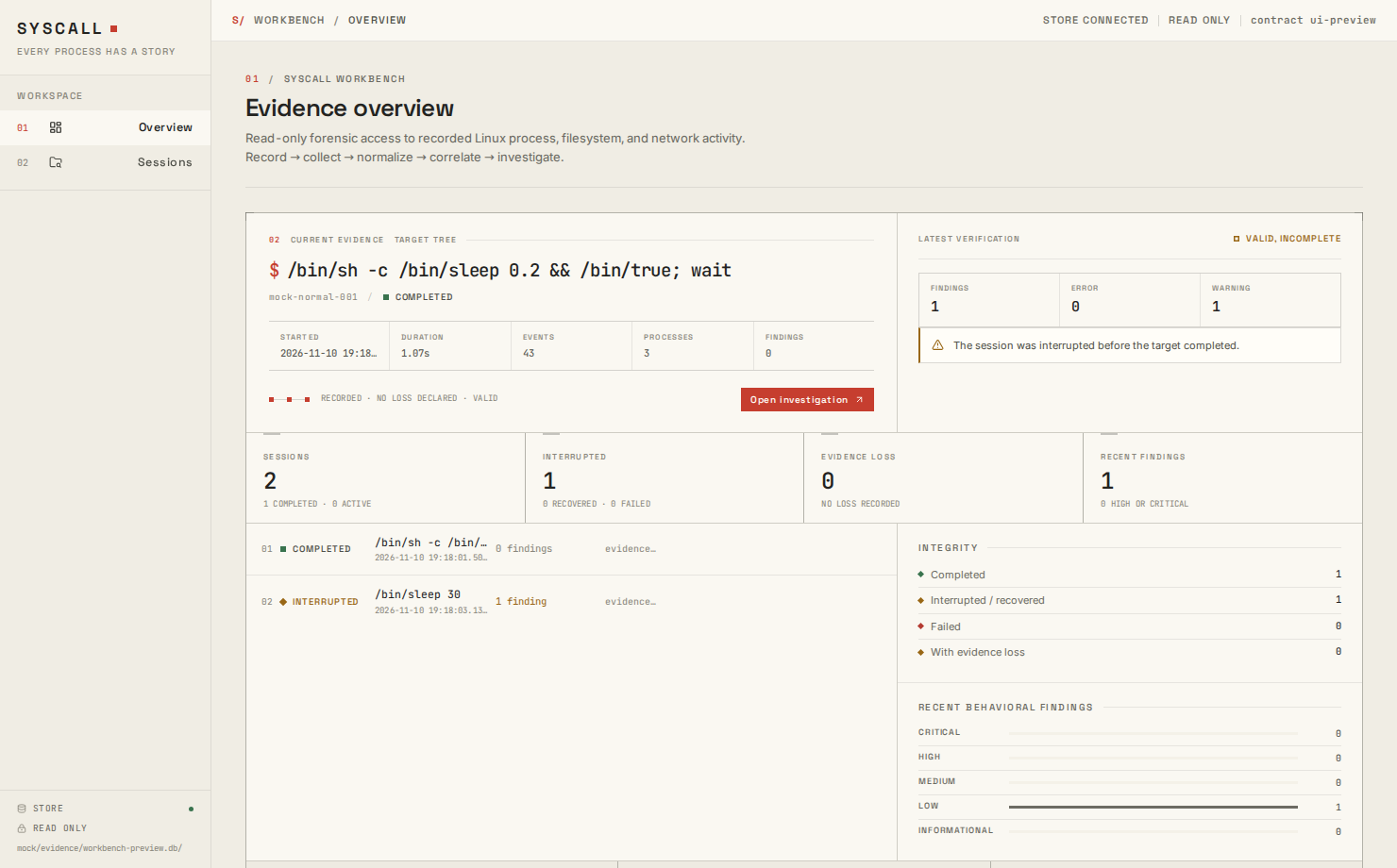
SYSCALL records process lifecycle, file-open, and IPv4/IPv6 connect activity with eBPF. It persists the result as a versioned SQLite evidence store and provides two read-only investigation surfaces: a command-line interface and a desktop workbench. The recorder is a local operator tool. It does not hide the fact that Linux tracepoints are system-wide, and it does not present incomplete collection as complete evidence. SYSCALL workbench evidence overview

Quickstart

Build the CLI, record a short session, and inspect the result in a few commands.

CLI reference

Every command, option, default, filter, and exit code in one place.

How it works

Tracepoints, decoding, attribution, storage, and the privilege boundary.

Workbench

Open a recorded database in the read-only desktop investigation surface.

What a session contains

A session also stores collection accounting, process-instance identity, timestamps, and provenance. That metadata is part of the evidence: a result with ring-buffer loss or unresolved ancestry is not equivalent to a complete recording.

One recorder, two read paths

Both read paths use the same storage queries, analysis engine, verification engine, and export logic. The desktop application does not reimplement forensic rules.

Design commitments

What SYSCALL does not do

SYSCALL does not capture file contents, packet payloads, memory, environment variables, DNS names, or keystrokes. A successful connect is not proof of an established session, TCP or UDP, reachability, or data transfer. An openat event is not proof of a read or write.
It also does not provide tamper-evident storage, a cryptographic chain of custody, kernel-side target filtering, or coverage for syscalls it does not hook. See Limitations before using the output in an investigation.

Documentation map